A temple is a carefully planned sacred environment in which architecture, orientation, movement, worship and ritual spaces come together. Temple Vastu considers these relationships through the traditional principles of Vastu Shastra, with attention to the purpose and layout of each sacred space.
Direction Vastu provides Temple Vastu Consultancy in Ahmedabad for temples, Mandirs, community worship spaces, residential Mandirs and new temple projects. The consultation can cover temple direction, entrance planning, Garbhagriha, deity placement, Pradakshina Path, Pooja areas, water elements, Yagya Kund and the overall temple layout.
Whether you are planning a new temple, renovating an existing one or reviewing a worship space, the assessment is tailored to the property's requirements and the intended use of the sacred environment.
Book a Consultation →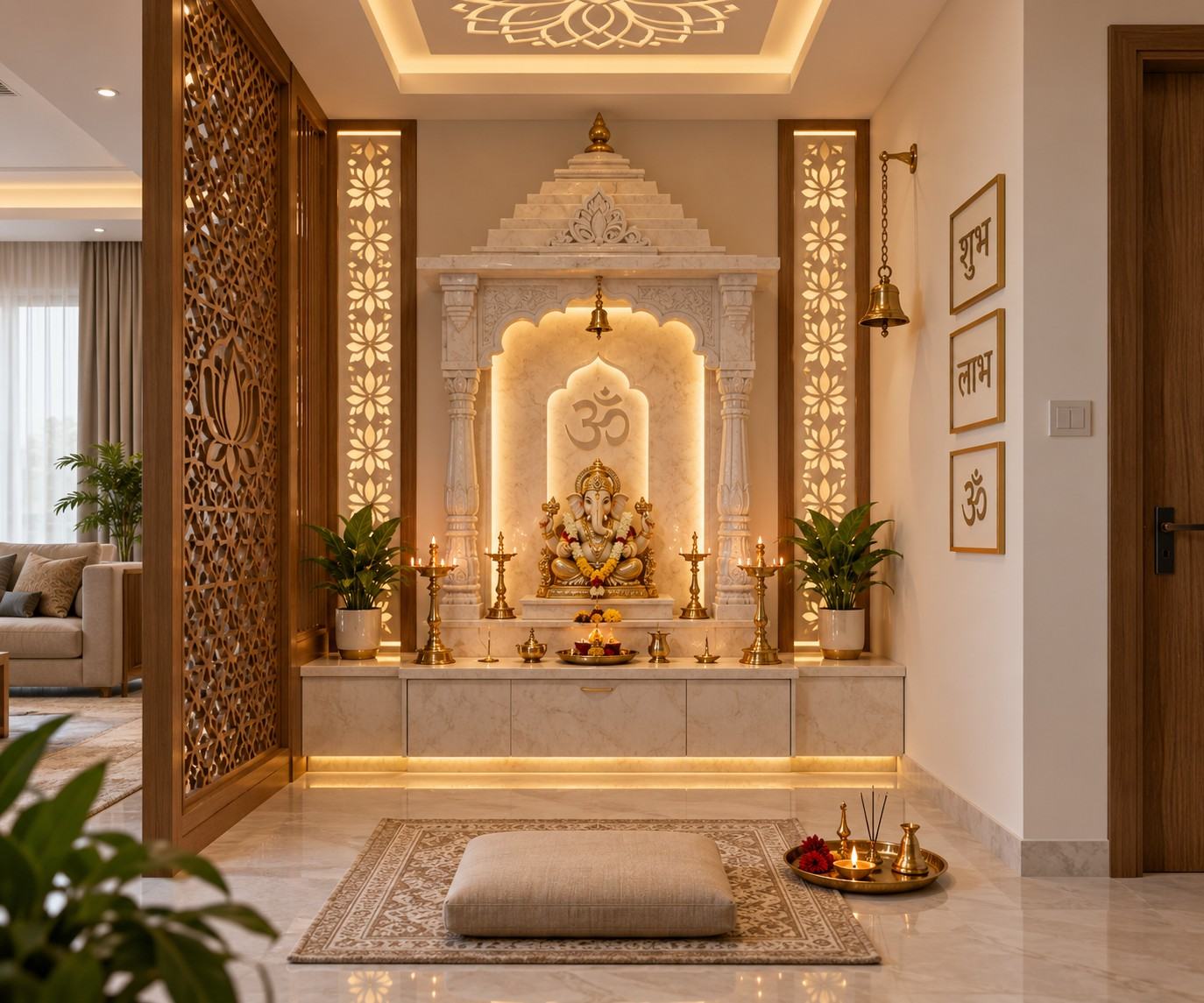
Planning a temple involves more than deciding where the shrine will be placed. The orientation of the property, entrance, Garbhagriha, deity placement, circulation, ritual spaces and areas used by devotees all contribute to the overall organisation of the temple.
A Temple Vastu Consultant can assess these elements in relation to traditional Vastu principles and the intended function of the space. The consultation may include the site's orientation, temple layout, entrance, Garbhagriha, deity placement, Pradakshina Path, Pooja areas and other important worship spaces.
For a new temple, these considerations can be reviewed during the planning and design stage. An existing temple can also be assessed to understand its current arrangement and identify relevant Vastu considerations.
Mandir Vastu Consultancy should be approached according to the type and purpose of the worship space. A large community temple, a residential Mandir and a traditional temple complex can have very different requirements. The assessment therefore needs to consider the actual property rather than applying one generic set of rules.
Vastu Shastra has traditionally been associated with the planning and organisation of spaces, including sacred environments. In temple planning, its principles are considered in relation to orientation, proportions, spatial hierarchy, movement and the placement of important areas.
Temple Vastu can therefore provide a traditional framework for considering how the temple site and its sacred spaces are arranged. Directional planning can be considered alongside the Garbhagriha, entrance, worship areas, circulation and spaces used by devotees.
The objective is to create a thoughtfully organised environment for worship and religious activity. A well-planned temple also needs to work practically for priests, temple committees, devotees, maintenance staff and visitors.
Temple Vastu Shastra should not be reduced to isolated directional rules. Traditional temple planning can involve several interconnected principles, and their application may vary according to the temple's tradition, scale, site, architectural form and intended use.
Importance of Directions: Direction is one of the fundamental considerations in traditional Vastu. The orientation of the site provides the basis for examining the placement of the temple building, entrance, Garbhagriha, deity, ritual areas and other spaces. Temple Direction as per Vastu should therefore be understood in relation to the complete site rather than as a single direction considered independently.
Five Elements: Traditional Vastu works with five elements: earth, water, fire, air and space. These principles form part of the traditional understanding of how different qualities are represented and balanced within a space. In a temple, they can be considered alongside open areas, water features, ritual fire, structural mass, circulation and enclosed sacred spaces. Their interpretation should remain connected to the overall temple plan rather than being treated as a collection of isolated placement rules.
Temple Entrance Planning: The temple entrance establishes the transition between the outside environment and the sacred precinct. Its direction, position, approach, relationship with the site and connection with devotee movement can be considered as part of the Vastu assessment. Vastu for Temple Entrance also needs to account for practical requirements such as accessibility, crowd movement, security and the relationship between the entrance and other temple spaces.
Garbhagriha Placement: The Garbhagriha is the principal sanctum of a traditional Hindu temple and has a central role in temple planning. Its position, proportions, orientation, relationship with the deity and connection with the surrounding temple spaces require careful consideration. Vastu for Garbhagriha should therefore be assessed within the complete temple plan and the architectural and religious traditions followed by the temple.
Deity Placement: Deity placement is a significant aspect of temple planning. Traditional Vastu considers the orientation and position of the deity in relation to the sanctum and wider temple layout. Vastu for Deity Placement should take into account the specific deity, temple tradition, sanctum arrangement, entrance axis, worship practices and other relevant considerations rather than relying on one universal rule.
Pradakshina Path Planning: The Pradakshina Path provides a designated route for devotees to circumambulate the sacred centre. Its relationship with the Garbhagriha, circulation, access points and surrounding spaces can be considered during planning. The path should also be practical for the expected movement of devotees and compatible with the physical configuration of the temple.
Water Element Placement: Water features may form part of the temple environment through tanks, fountains, water points, or other designated areas. Their position can be considered within the traditional Vastu framework and the overall site plan. Practical factors such as drainage, maintenance, hygiene, water management and visitor safety should also be incorporated into the planning.
Yagya Kund Placement: The Yagya Kund is associated with ritual fire and therefore has a distinct function within spaces where yajna or homa is performed. Its location, orientation, access, ventilation and relationship with surrounding worship areas can be considered in accordance with the temple's ritual requirements and traditional Vastu principles.

Main Temple Entrance: The entrance can be assessed for its direction, placement, approach, relationship with the temple structure and connection with devotee movement. Traditional Vastu considerations should be interpreted according to the complete site rather than treating one entrance direction as universally applicable.
Garbhagriha: The Garbhagriha requires particular attention because it forms the principal sanctum. Its location, orientation, proportions, access and relationship with the deity and surrounding spaces can be reviewed as part of Vastu for Garbhagriha.
Deity Placement: Deity orientation and placement can be considered in relation to the sanctum, entrance, temple axis, ritual practices and the specific traditions followed by the temple.
Pradakshina Path: The Pradakshina Path can be reviewed for its relationship with the Garbhagriha, movement patterns, access, width and connection with other sacred areas.
Pooja Areas: Vastu for Pooja Room and Mandir considers the placement and orientation of worship areas within the overall layout. In residential Mandirs, this may involve a smaller dedicated space, while larger temples may have several ritual and worship areas.
Yagya Kund: The Yagya Kund can be assessed according to its ritual purpose, location, orientation, surrounding space, ventilation, access and relationship with other worship areas.
Water Features: Water elements can be considered in relation to the site's orientation, temple layout, drainage, maintenance and intended purpose.
Devotee Areas: Waiting, gathering, seating, circulation, shoe-storage, drinking-water and other devotee facilities can be reviewed as part of the wider temple plan. The objective is to maintain a clear relationship between sacred spaces and the movement and practical needs of visitors.
A professional Temple Vastu assessment can help bring greater clarity to the organisation of a temple or Mandir and its sacred spaces.
Potential benefits include:
For temple trusts, committees, architects, and individuals, Mandir Vastu Consultancy can provide a structured way to review the relationship between traditional Vastu principles and the actual worship space.
Initial Consultation: The consultation begins with understanding the temple project, its purpose, religious and architectural requirements, site conditions, development stage and the areas that need assessment.
Site Assessment: Where applicable, the site can be reviewed to understand its orientation, configuration, access, existing structures, open areas and relationship with the proposed or existing temple.
Directional Analysis: The site's orientation and the placement of important temple functions are examined in relation to traditional Vastu principles.
Temple Floor Plan Review: The floor plan is reviewed to understand the relationship between the entrance, Garbhagriha, deity, Pradakshina Path, Pooja areas, ritual spaces, devotee areas and supporting functions.
Garbhagriha Assessment: The sanctum is examined as a key part of the temple plan, considering its position, orientation, relationship with the deity, access and surrounding spaces.
Deity Placement Assessment: The deity's placement and orientation are reviewed within the context of the Garbhagriha, temple axis, worship practices and relevant traditional considerations.
Vastu Recommendations: The findings are translated into recommendations relevant to the temple and its intended use. Where changes are proposed, they should be considered alongside architectural requirements, structural feasibility, safety, accessibility, religious traditions and applicable regulations.
This approach makes Vastu for Temple Construction a considered planning exercise rather than a fixed list of isolated placement rules.
Temple projects often involve multiple stakeholders, including temple trusts, committees, architects, designers, priests and community representatives. A useful Vastu consultation therefore needs to account for the actual site, the intended worship practices, and the planned temple layout.
Direction Vastu provides a Temple Vastu Consultant approach focused on customised assessment and traditional Vastu guidance for both new and existing worship spaces.
For new projects, Vastu for Temple Construction can be considered during the planning stage, when decisions regarding orientation, layout, Garbhagriha, deity placement, entrance, circulation and supporting spaces are being developed.
For existing temples, the current site and layout can be reviewed to identify relevant Vastu considerations and determine what changes, if any, may be practical.
The consultation is designed around the individual temple rather than assuming that the same recommendations apply to every Mandir.
If you are planning a new temple, renovating an existing one, or reviewing a worship space, discuss the requirements of your project with Direction Vastu.
Direction Vastu provides Vastu for Temples across different worship environments, including Hindu temples, Mandirs, community temples, residential Mandirs, Pooja rooms, and other spiritual and worship spaces.
The consultation can also support new temple projects and renovation projects where the layout is being planned or reviewed. Vastu for Mandir is considered according to the property's scale, purpose, architectural arrangement, worship practices and available space.
A residential Pooja room may require a very different assessment from a large community temple, so recommendations are developed around the actual worship environment and its intended use.
Vastu for Temple Construction can begin with the site's orientation and the overall temple layout. Temple Direction as per Vastu and Mandir Direction as per Vastu can then be considered alongside the main entrance, Garbhagriha and deity placement. Vastu for Temple Entrance may examine the entrance's position, approach, and relationship with the sacred precinct.
Vastu for Deity Placement and Vastu for Garbhagriha consider the sanctum and its relationship with the temple plan. The Pradakshina Path, Pooja areas, Yagya Kund, water elements, devotee areas and supporting spaces can then be assessed as parts of the complete layout.
The objective is a coherent temple plan grounded in traditional Vastu considerations.
